
NATIONAL NEWS
Subsidy Removal, Naira Float Triggered Unprecedented Inflation, Poverty – Rev. Fr. Ehusan

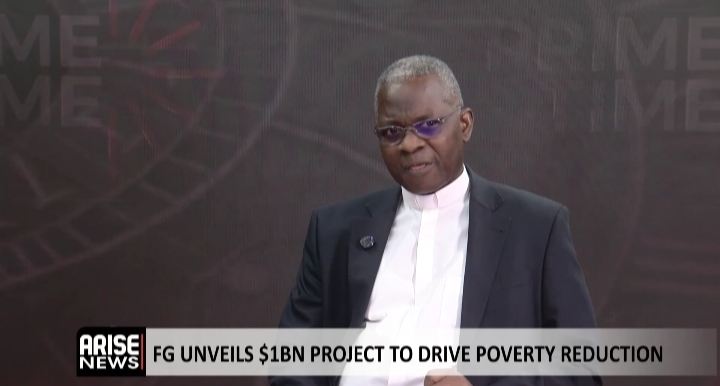
Rev. Fr. George Ehusan, Executive Director of the Lux Terra Leadership Foundation, has criticised the Federal Government’s economic policies, saying the removal of fuel subsidy and subsequent floating of the naira plunged Nigerians into a level of inflation and poverty he had never witnessed in his lifetime.
Ehusan, who spoke at Arise TV’s Prime Time show on the government’s recently announced poverty-reduction initiative, questioned the timing of the programme, describing its unveiling in 2026, months ahead of the 2027 general elections, as “a lot of hype” and expressing doubts about its ability to significantly improve the lives of Nigerians.
According to him, the economic hardship currently experienced by Nigerians cannot simply be explained as a continuation of the hunger and poverty that existed before the present administration.
He said, “The president did say that there was hunger before he was born, which for me was a very unfortunate statement, because I am going towards my 69th birthday, and the kind of poverty we have seen in this country in the last three and a half years, I never saw it when I was born.”
Ehusan said he had never witnessed the level of deprivation currently experienced by Nigerians, including adult men begging for basic food on the streets.
“I never saw adult men begging on the road for food. Never saw this number of people. In the environment where I grew up, I never saw people begging for food, basic food. So I never saw, in my own environment, this kind of poverty,” he said.
He traced the worsening economic hardship to the policies implemented by the administration after its inauguration in May 2023, particularly the removal of the fuel subsidy and the floating of the naira.
“On the 29th of May, 2023, we heard the announcement: the subsidy is gone. It was followed by the floating of the naira. That took us to an inflation, a degree of inflation that we had never seen before, 300 to 400 per cent, everything,” he said.
He argued that the government had sufficient time to prepare for the consequences of subsidy removal, noting that nearly three months elapsed between the presidential election and the May 29, 2023 inauguration.
“The policies, we have ended up where we have ended up, because of policies that are not well thought out. You put the cat before the horse, because how do you remove the subsidy? You had how many months? Almost three months between the election and the swearing-in. That was long enough time to plan, and if you are going to remove the subsidy, you should have known that there will be consequences,” Ehusan said.
He argued that measures to cushion the impact of subsidy removal should have been introduced immediately after the policy was announced.
“This kind of project should have come immediately on May 30th, after removing the subsidy on May 29th, 2023,” he said.
Ehusan also questioned the Federal Government’s plan to deploy ₦1.4 trillion to address poverty, arguing that the amount would be insufficient to transform the lives of the millions of Nigerians described as extremely poor.
He said the government’s announcement, coming several months before the elections, raised questions about its motivation and likely impact.
“Now it is coming in 2026, several months, six months, several months to the elections. For me, it’s a lot of hype, but I really wonder how much benefit it will bring to the Nigerian people,” he said.
Comparing the proposed ₦1.4 trillion intervention with the cost of other government projects, Ehusan questioned how the amount could produce the claimed transformation.
“By the way, what you are talking about is ₦1.4 trillion. But we went ahead and were awarded a contract, a ₦15 trillion water contract for the Lagos-Calabar Coastal Highway,” he said.
He added, “So how we, Nigeria that has the money to award a ₦15 trillion Lagos-Calabar Highway, you are talking of ₦1.4 trillion, is going to transform Nigeria, and it’s going to transform the 130 terribly poor Nigerians to, what do they call it, poverty graduation. I don’t see that happening.”
According to him, a simple calculation shows that if ₦1.4 trillion were divided among 130 million extremely poor Nigerians, each person would receive only about ₦10,700.
“I try to do the arithmetic immediately. Say, look, if you have 130 very poor Nigerians, ₦1.4 trillion will give them ₦10,700. Now, what can ₦10,700 do?” he asked.
Ehusan also questioned the reliability of the population figures being used to design and implement the programme.
“We have not even asked the basic question, the fundamental question: based on what data? Nigeria has not had a census exercise, for all I know, for about 20 years. So the truth is that we really don’t know how many we are. We are only using estimates. We don’t know how many we are,” he said.
He noted that Nigeria’s estimated population of about 230 million is being used alongside an estimate of up to 130 million multi-dimensionally poor Nigerians to justify the intervention.
“I am seeing, in the context of a population that is estimated to be 230 million, with terribly poor people, I mean, multi-dimensionally poor people, being estimated to be up to 130 million, we are talking of ₦1.4 trillion as that magic amount that is going to transform the people. I see that as a bit of a joke,” he said.
“Despite the hype that happened yesterday at Aso Villa, I think it’s a bit of a joke.”
The cleric further argued that the government should focus on addressing insecurity and creating an environment where Nigerians can work and provide for themselves rather than relying on palliatives.
“Nigerians are not asking for palliatives; it is an insult. Nigerians are hard-working and creative people; they can take care of themselves. All they need is to provide security and ensure utilities are not beyond their reach,” Ehusan said.
He maintained that fixing insecurity should be a major priority for any government genuinely interested in reducing poverty.
“If the government wants to reduce poverty, they need to fix insecurity,” he said.
Ehusan also expressed concern about the implementation of previous poverty-alleviation programmes, pointing to corruption allegations involving some officials who administered earlier interventions.
“When you think of the programmes that have happened in the past, with a lot of the people who are the ministers and directors of those facing the EFCC and ICPC for corruption, a lot of that money did not get to the poor,” he said.
He consequently challenged the present administration to demonstrate why Nigerians should expect a different outcome from the latest intervention.
“So what does the present government have to show that this one will be different? I don’t know,” Ehusan said.

For publication of your news content, articles, videos or any other news worthy materials, please send to newsleverage1@gmail.com. For more enquiry, please call +234-901-067-1763 or whatsapp +234-901-067-1763. To place an advert, please call 09010671763




Ex-Army Chief Ihejirika Endorses Otti, Bourdex Ahead of 2027 Election

2027: Hon. Chidi Nnamdi Urges Obioma–Ngwa Voters to ‘Try Something Different’

Breaking! Arochukwu Kingdom Hosts World to Ikeji-Aro 2026, Says Festival Goes Beyond Prizes

‘Your Works Will Campaign For You’ – Bishop Echema to Otti As Governor Vows To Build Priests’ Retirement Home

MOUAU Denies Attempt To Sack Council Members, Says Their Tenure Expired

Sowore as Best President Nigeria Refuses to Have – Kperogi

NHRC Investigates Deaths of 37 Suspected Miners in NSCDC Custody

Hon. Chidi Nnamdi Pledges People-Centred Development for Obioma-Ngwa Constituency

‘We Won’t Allow Wike to Use APC To Build His Party’ – Farouk Aliyu

Dangote Refinery IPO Success Linked To Deregulation, Subsidy Removal – Lokpobiri

Tinubu: ‘Senator, We Are Not With You’ – Community Tells Senator Ohuabunwa

NDC Notified Benue Police Ahead of Peter Obi’s Visit, Document Shows

35 Years After Kirikiri Release, Abdul Mahmud Remembers Bamidele Aturu, Says ‘The Struggle Remains Unfinished’

Ibeku Traditional Rulers Endorse Chinedum Orji for Ikwuano/Umuahia Federal Constituency

Tension in Benue as Peter Obi’s Blocked Convoy Leads to Protest

Abia Govt Explains Teacher Recruitment Process, Discloses Number of Candidates Who Scored Over Benchmark

Iwa Ji Festival: Ikuku’s Cultural Connection With Ibeku People Signals Strong Constituency Bond – Group

Ikeji-Aro 2026: ‘We Are Repackaging Aro Traditional Healing Practices for the Younger Generation’ – Mazi Ernie Onwumere

APC Sanctuary: How the Ruling Party Became Nigeria’s Governance Virus – Otunba Babatunde Olushola Senbanjo

Ikeji-Aro 2026: CPC Chairman Elekwa Explains ‘Aro Renaissance’ Theme, Reveals Plans to Preserve Cultural Heritage

The final 6 ‘Game of Thrones’ episodes might feel like a full season
New Season 8 Walking Dead trailer flashes forward in time
Mod turns ‘Counter-Strike’ into a ‘Tekken’ clone with fighting chickens
Meet Superman’s grandfather in new trailer for Krypton
Disney’s live-action Aladdin finally finds its stars
Who are the early favorites to win the NFL rushing title?
The old and New Edition cast comes together to perform
Boxing continues to knock itself out with bewildering, incorrect decisions
Steph Curry finally got the contract he deserves from the Warriors
Phillies’ Aaron Altherr makes mind-boggling barehanded play
-
 POLITICS2 weeks ago
Tinubu: ‘Senator, We Are Not With You’ – Community Tells Senator Ohuabunwa
-
 NATIONAL NEWS2 weeks ago
NDC Notified Benue Police Ahead of Peter Obi’s Visit, Document Shows
-
 Articles3 weeks ago
35 Years After Kirikiri Release, Abdul Mahmud Remembers Bamidele Aturu, Says ‘The Struggle Remains Unfinished’
-
 POLITICS3 weeks ago
Ibeku Traditional Rulers Endorse Chinedum Orji for Ikwuano/Umuahia Federal Constituency
-
 NATIONAL NEWS2 weeks ago
Tension in Benue as Peter Obi’s Blocked Convoy Leads to Protest