
Abia State News
‘Ask me Anything’ – Otti to Ngwa Diaspora in Houston, Secures Fresh Support

By Prince Okey Kanu
(Hon. Commissioner for Information, Abia State)
There are engagements where a politician speaks and an audience listens. Then there are encounters where a leader walks into a room knowing that every word, every figure and every promise will be interrogated.
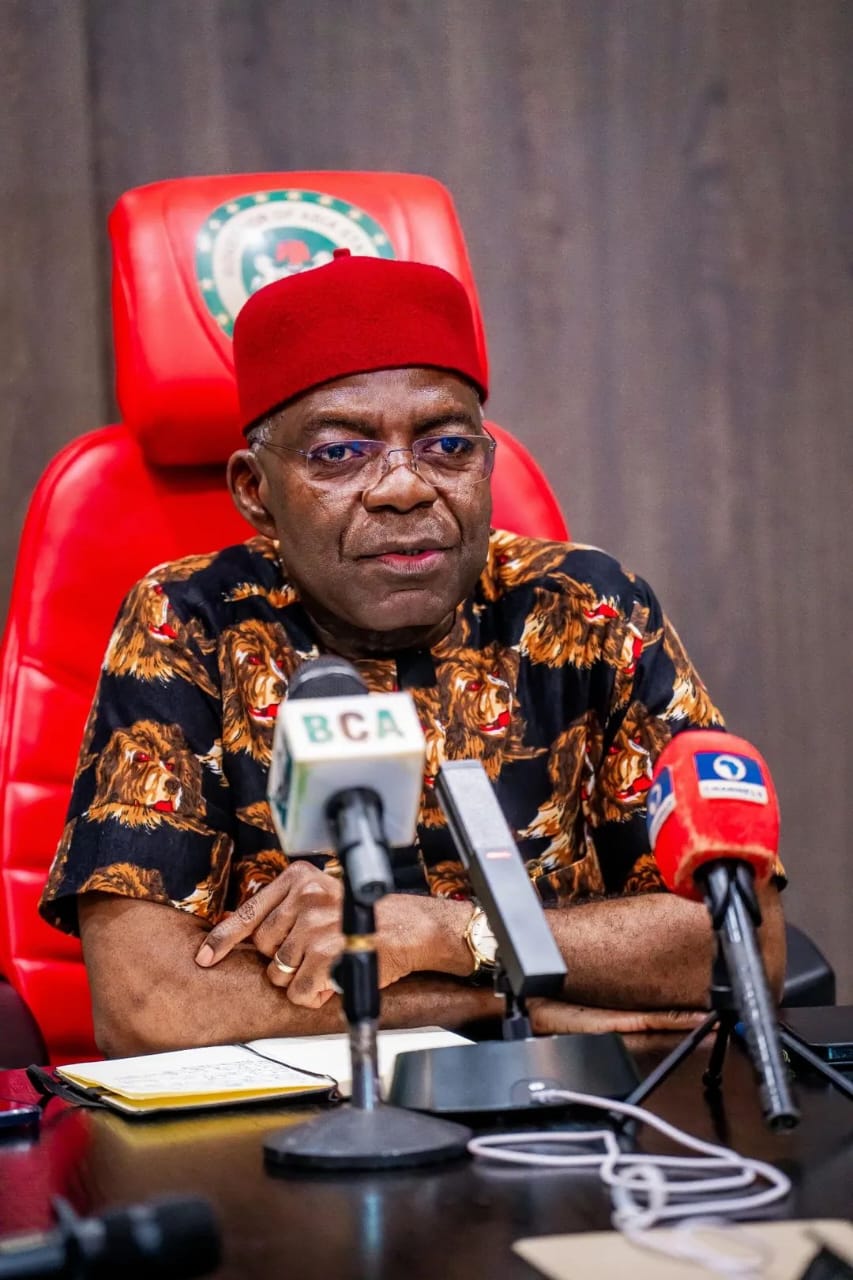
His Excellency Dr. Alex Chioma Otti’s engagement with the Ngwa National Association, USA (NNAUSA), during its 35th Annual Convention in Houston, Texas, belonged firmly to the second category.
It was not simply another diaspora meeting. It was, in many respects, a political and intellectual town hall where the Governor was confronted with questions about infrastructure, healthcare, security, pensions, gratuities, investment, the proposed Nsulu Airport and the future direction of Abia State.
And Gov Otti did something particularly significant: he allowed the evidence to speak before he began answering the questions.
The strategic importance of the Houston encounter lies in the audience itself. Ngwa professionals, entrepreneurs, academics, medical practitioners and other accomplished Abians living in North America are not disconnected observers of what happens at home. Many maintain strong emotional, economic and professional links with Abia and, importantly, possess the capacity to influence investment, expertise and public opinion about the state. For such an audience, political rhetoric alone would hardly have been sufficient. That appeared to be why Governor Otti chose a different route.
Rather than arriving with what he described as a written speech designed to keep the audience occupied, he invited them to take a journey with him through the Abia he inherited in May 2023 and the Abia his administration is building today. The documentary presentation became one of the defining moments of the evening.
Images and videos showing some of the major roads and infrastructure facilities as they were before the commencement of the administration were juxtaposed with their present condition and ongoing reconstruction. The old Port Harcourt Road, Ohanku Road, Omenuko Bridge, the Ndiegoro drainage project, Omuma Road and the Uratta/Old Express corridor were among the projects that featured prominently. For an audience watching from thousands of kilometres away, the visual evidence carried a different weight. It was no longer a matter of political claims being made from a podium. They could see the before-and-after story for themselves.
The presentation also highlighted the administration’s interventions in waste management and other areas of urban renewal, particularly in Aba, giving the audience a broader picture of the scale of the transformation being pursued. The reaction that followed was telling.
Applause swept through the hall. But perhaps the more important development came afterwards. Gov Otti opened the floor. That was when the Houston meeting transformed from a presentation into a genuine town hall.
Questions began coming from different directions, and the Governor listened, took notes and responded to issues ranging from local roads to international investment, from healthcare manpower to security, and from airport development to the payment of long-standing pension and gratuity obligations.
The Governor’s insistence that the moderator ensure women had equal opportunity to participate was also noteworthy. It reinforced the administration’s stated commitment to ensuring that women are not treated as spectators in conversations about governance and development.
Among the issues raised was the Mgboko road linking the area towards Obingwa through Hotel De Laurel. The question, reportedly raised by Lady Blessing Chioma Ahuama after commending the Governor over the recently commissioned Chima Ubani General Hospital in Mgboko, provided Gov Otti an opportunity to speak directly about a project that matters to residents on the ground.
His response was straightforward: work was already ongoing, and he assured her that the road would be completed before she returns to Nigeria for the festive period. That exchange demonstrated one of the most important features of the meeting, the ability of the audience to move the conversation from broad government achievements to specific projects that directly affect communities.
The healthcare conversation was equally revealing. Several Ngwa professionals in the Diaspora, particularly those in the medical field, expressed interest in contributing their expertise to Abia’s healthcare system.
Rather than treating their interest as merely another expression of goodwill, Gov Otti moved the conversation towards a practical pathway, indicating that they could be connected with the Commissioner for Health through the President/CEO of NNAUSA, Dr. Ugo Agu.
For a government facing the challenge of retaining and attracting highly skilled professionals, especially in specialised areas, such connections could become strategically important.
Then came the question of the Nsulu Airport.
A participant from Isialangwa North asked the Governor for assurance that the airport would be completed before the end of his eight-year tenure.
Gov Otti’s answer was perhaps one of the clearest demonstrations of how the administration is approaching the project. He explained that the airport is a collaborative project involving the Abia State Government and the Federal Government.
According to the Governor, the initial federal proposal was for an airstrip, but he questioned why Abia should stop at an airstrip when the facility could become a full airport. The result, he explained, was a decision by the state government to take responsibility for the runway, which is currently under construction, with the expectation that the runway will be completed by 2027.
The Federal Government, he said, would then be expected to undertake the terminal and other components of the airport project. That response went beyond offering a political assurance. It clearly identified the different responsibilities attached to the project.
And that distinction matters.
It means that when the time comes to assess the progress of the Nsulu Airport, Abians will have a clearer understanding of which component falls within the responsibility of the state government and which depends on the Federal Government. The investment conversation was another critical component of the engagement.
The Governor used the opportunity to tell the Diaspora that Abia is increasingly creating the conditions required for serious investors to return to the state. His reference to the Starpaper Mill acquisition and other industrial assets available for investors was particularly significant.
For years, one of the biggest questions surrounding Abia has been how to convert its enormous entrepreneurial energy into structured industrial growth and sustainable employment. The message from Houston was therefore not simply “come home and invest.”
It was closer to: the environment is changing; the infrastructure is being rebuilt; opportunities are emerging; come and participate. That is an important shift in the relationship between government and the Diaspora. Instead of viewing Abians abroad principally as people who send money home, the administration is positioning them as potential investors, professionals, technical partners and participants in the rebuilding of the state.
The Governor was equally direct when the conversation moved towards security. He did not attempt to turn sensitive security matters into public spectacle. While declining to expose details that should ordinarily remain outside public consumption, he assured the audience that security remains a serious priority of his administration. His handling of the pension and gratuity questions was similarly significant.
Gov Otti explained the administration’s ongoing effort to clear liabilities accumulated over several years, including the recent payment covering the 2001–2010 period and plans to progressively address subsequent years. But he went beyond the accounting. He explained the economic logic behind the payments. When government pays pensioners and retirees what they are owed, the money does not simply disappear into individual pockets. It circulates through the economy. Pensioners buy from traders. Traders purchase goods. Producers receive patronage. Service providers earn income.
In other words, clearing pension and gratuity arrears becomes not only a moral obligation but also an economic intervention. That perspective provided an important insight into the administration’s approach to inherited liabilities. Rather than pretending the debts do not exist, the government is attempting to confront them progressively. The road infrastructure conversation also produced fresh commitments.
Gov Otti reminded the NNAUSA audience that the reconstruction of Port Harcourt Road and Ohanku Road had already been undertaken, while Omuma Road was ongoing. He further disclosed plans to flag off the reconstruction of the Uratta/Old Express Road by October 2026, with additional roads expected to receive attention across Aba and other parts of the state. But perhaps the most politically consequential moment of the evening came at the end. The meeting was not concluded merely with applause. It ended with an expressed endorsement of Governor Otti for the 2027 governorship election and a declaration of willingness by members of the Diaspora community to continue contributing to the development of Abia. That development gives the Houston meeting a significance beyond the four walls of the convention venue.
Diaspora communities are often difficult constituencies for politicians to impress because their distance from home gives them access to alternative sources of information and allows them to scrutinise developments in their states from multiple perspectives.
They also tend to ask a different class of questions. They want to know what happened to the money. They want to know what is being built. They want timelines. They want accountability. They want to know whether a project is actually sustainable. And when they ask questions, they often do so without the political restraints that can accompany domestic engagements.
That is why Gov Otti’s decision to face the NNAUSA audience with documentary evidence and then submit himself to an extended question-and-answer session was strategically important. It placed his administration’s record under scrutiny before a constituency with considerable influence, resources and connections. It also demonstrated something about the Governor’s communication strategy. Show them what you inherited. Show them what you have done. Then allow them to ask you anything. That was essentially the architecture of the Houston encounter. The significance of the meeting therefore goes beyond the applause that greeted the Governor’s presentation or the endorsement that followed.
It was about trust. It was about rebuilding the relationship between Abia and its Diaspora. It was about convincing professionals who live thousands of kilometres away that there is now a credible reason to look towards home again not merely with nostalgia, but with investment plans, expertise and partnerships. And perhaps most importantly, it was about giving Ndi Ngwa in North America an opportunity to interrogate the man occupying the highest political office in their home state directly.
By the time the session ended, the Governor had not answered every question, time simply would not permit it. He consequently shared the contact of his Principal Secretary, Mr. Chinenye Mba-Uzokwu, encouraging participants to continue the conversation and pursue areas of partnership. That was significant too. Because the most successful diaspora engagement is not the one that ends when the microphone is switched off.
It is the one that produces conversations, investments, professional collaborations, policy feedback and sustained engagement long after everyone has left the hall.
The Houston town hall may therefore be remembered not merely as another appearance by Governor Alex Otti in the United States, but as a moment when the New Abia project was subjected to the questions of an influential Diaspora constituency and emerged with renewed confidence from the audience.
From the roads of Aba to the proposed runway at Nsulu, from hospitals to healthcare professionals, from industrial assets to pension liabilities, the questions were varied.
The Governor’s answers were equally varied. But the larger message was remarkably consistent: Abia is being rebuilt deliberately, the administration believes its record can withstand scrutiny, and the Diaspora is being invited not just to watch the transformation, but to become part of it.
In Houston, the conversation was about more than three years of governance. It was about the next chapter. And if the reaction at the NNAUSA convention is anything to go by, Governor Otti may have left Houston with something considerably more valuable than applause: a stronger bridge between Abia and a Diaspora community that now appears increasingly ready to invest its confidence, expertise and resources in the New Abia project.

For publication of your news content, articles, videos or any other news worthy materials, please send to newsleverage1@gmail.com. For more enquiry, please call +234-901-067-1763 or whatsapp +234-901-067-1763. To place an advert, please call 09010671763




2027: Hunger, Not Political Permutations, Will Defeat Tinubu – Dele Momodu

Tinubu and INEC Cannot Hide 103 Million Names and Expect Nigerians to Trust 2027 Election – Atiku

Ebola: Africa CDC Reveals Origin of Ebola Patient in Nigeria, Seeks Cooperation

‘One Day, We Will End Up Six Feet’ – Obi Says, Mourns NDC Supporter Killed in Enugu Campaign Attack

Of Turncoats and the Treachery of Yesterday’s Radicals – Abdul Mahmud
Ebola: Africa Better Prepared To Tackle Outbreaks – Africa CDC DG

Emenike Hospital Attacked Days After Footballer Criticised Alleged Corruption in Imo

Otti Flags Off Old Express, Uratta Road Reconstruction, Declares End to Aba’s Infrastructure Nightmare

2027: Ikuku Pledges Three Modern Skills Acquisition Centres for Ikwuano/Umuahia Constituency

2027: Bishop Sunday Onuoha Endorses Bourdex for Abia North Senate, Hails Him as Pathfinder

Ikeji Aro 2026 on Avor Osu Day: Nkita Oku, Inum, Ekpe Erim, Other Ekpo Masquerades Pay Homage to Eze Eberechukwu Oji

97-Year-Old Dr Mrs. Shields Reconstructs, Reopens Mary Slessor Library in Arochukwu

Cardinal Onaiyekan: Governor Alia Was Suspended for Defying Catholic Church Rules on Politics

2027: Hon. Ike Bishop Okoronkwo Mobilises Abia North Grassroots, Tasks ADC Coordinators on Polling Units

Eze Eberechukwu Oji Commissions Amuvi Community Self-Built Connectivity Hub

Eze Eberechukwu Oji Receives New Book on Arochukwu’s Cultural Heritage, Eulogizes Author

‘We Will, We Will, We Will’: Atiku Slams Tinubu Over Promises, Questions Achievements After Three Years

NIGERIA at 66: What is the Way Forward? – Otunba Babatunde Olushola Senbanjo Calls for Rescue, Rebuild and Restore the Nation

Leave Chidi Nnamdi Alone, Earn the People’s Trust – New Direction Agenda

“Tinubu Must Go”: Otunba Babatunde Olushola Senbanjo Accuses President of Constitutional Breach Over 21-Day Absence

The final 6 ‘Game of Thrones’ episodes might feel like a full season
New Season 8 Walking Dead trailer flashes forward in time
Mod turns ‘Counter-Strike’ into a ‘Tekken’ clone with fighting chickens
Meet Superman’s grandfather in new trailer for Krypton
Disney’s live-action Aladdin finally finds its stars
Who are the early favorites to win the NFL rushing title?
The old and New Edition cast comes together to perform
Boxing continues to knock itself out with bewildering, incorrect decisions
Steph Curry finally got the contract he deserves from the Warriors
Phillies’ Aaron Altherr makes mind-boggling barehanded play
-
 Abia State News4 weeks ago
Ikeji Aro 2026 on Avor Osu Day: Nkita Oku, Inum, Ekpe Erim, Other Ekpo Masquerades Pay Homage to Eze Eberechukwu Oji
-
 Abia State News4 weeks ago
97-Year-Old Dr Mrs. Shields Reconstructs, Reopens Mary Slessor Library in Arochukwu
-
 POLITICS4 weeks ago
2027: Hon. Ike Bishop Okoronkwo Mobilises Abia North Grassroots, Tasks ADC Coordinators on Polling Units
-
 NATIONAL NEWS2 weeks ago
Cardinal Onaiyekan: Governor Alia Was Suspended for Defying Catholic Church Rules on Politics
-
 Abia State News4 weeks ago
Eze Eberechukwu Oji Commissions Amuvi Community Self-Built Connectivity Hub