
Articles
Nigeria Owes Tobi Amusan a Statue – Abdul Mahmud

By Abdul Mahmud

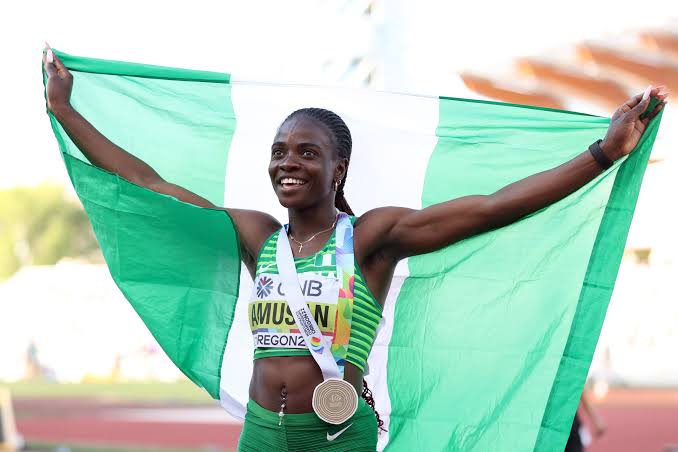
Some countries build monuments to their heroes because they understand something that Nigeria appears to have forgotten: a nation does not preserve its memory by allowing history to remain in books, archives and speeches alone; it gives memory a physical address, places the faces of its heroes in the public square and tells succeeding generations, through bronze and stone, that these are the men and women whose lives enlarged the meaning of the country they served; Nigeria should begin such a conversation with Tobi Amusan, and I would go further: I think Nigeria owes her a statue.
The argument has little to do with athletics alone, and even less to do with the transient excitement that accompanies victory on a track, for Amusan did something considerably larger than win a race: she placed the Nigerian flag at the summit of world athletics, became the first Nigerian world champion in an athletics event, broke the world record in the 100 metres hurdles in Eugene in 2022 with 12.12 seconds, and returned almost immediately to win the world title in a manner that transformed her from a gifted athlete into part of the country’s permanent sporting history. The world record has now been taken from her by America’s Masai Russell, but records move, champions change, and sporting history keeps rewriting itself; what cannot be erased from Nigerian history is that Amusan was the first Nigerian athlete to hold a world record and win a World Athletics Championships title.
A statue would therefore not be a reward for a race, nor an ornamental gesture towards a successful sportswoman, but a public declaration about the kind of citizenship Nigeria chooses to honour; in a country where too much public space has been appropriated or effectively privatised by people whose careers have left the country poorer in both material and moral terms, there is something almost radical about returning the public square to the public and filling it with the likenesses of people whose achievements belong to everyone. Nigeria has become remarkably generous with the elevation of political power into public memory, with the names and images of officeholders appearing on roads, buildings, and institutions, while their records remain contested, but the people who have given the country reasons to feel proud are too often left with medals, photographs and the fading applause of ceremonies. Other countries understand the difference. Britain has placed Nelson Mandela in Parliament Square in London, among figures whose public lives have become part of the moral language of the country and the wider world; India has filled its public spaces with monuments to Gandhi, Ambedkar and other figures whose lives are inseparable from the country’s history;
Such monuments do something more than preserve likenesses. They tell a nation what deserves remembrance.
Nigeria has no shortage of people deserving such remembrance. The country has produced writers who enlarged the African imagination, scientists whose work travelled beyond our borders, athletes who made the Nigerian flag visible on the greatest stages of world sport, soldiers and civilians who paid the ultimate price in moments of national crisis, teachers who spent entire lives educating children without receiving anything approaching the honour accorded to less deserving public figures, and ordinary citizens who performed extraordinary acts of courage without cameras, government delegations or ceremonial titles. Joseph Blackson should belong to this conversation. In 2018, when a passenger boat capsized in Rivers State, Blackson, a 36-year-old diesel supplier and father of two, repeatedly entered the water and rescued 13 people; he was attempting to rescue the 14th when he died. There is something deeply unsettling about the fact that such a man can disappear almost completely from national memory while the names and faces of men who have done considerable harm to the public good remain permanently reproduced across Nigeria’s civic landscape.
Abuja offers us an extraordinary opportunity to correct this imbalance. The Federal Capital is a city of hills, and those hills already give the capital a natural scenery from which to contemplate the city below. I would like to see Nyesom Wike, the Minister of the Federal Capital Territory, consider turning one of those hills into a national place of remembrance, perhaps the hills around the intersection of the road beyond NICON Junction and the expressway running from the AYA Junction towards Gwarinpa, into what might appropriately be called Heroes’ Hills. Or the hills overlooking the city gate. Imagine approaching Abuja and seeing, rising above the metropolis, the statues of Nigerians whose lives have given the country something larger than political office: Amusan standing with the quiet authority of an athlete who carried the Nigerian flag to the summit of world sport; Blackson looking towards the city whose citizens he once risked his life to save; and, alongside them, the men and women whose courage, intellectual achievement, sacrifice, or service have enlarged the grand Nigerian story.
The idea has an appealing symbolism because Abuja was conceived as the capital of a nation that sought a common centre, a place that could stand above the claims of particular regions and speak to the idea of Nigeria as one country. What better place, then, for a hill of heroes? From such a height, the statues would look over a city that represents the Nigerian idea of unity, while the city below would look upwards towards people whose achievements belong to no single ethnic group, religion or political party. Heroes’ Hills could become a place where a Nigerian child from Sokoto stands beside another from Rivers and sees in the monuments a shared inheritance; a young athlete from Edo could encounter Amusan’s story and imagine a future of her own, while the story of Blackson could remind another child that heroism does not require office, wealth or fame. A visitor to Abuja would encounter not another monument to political power, but a hillside devoted to the memory of people who gave something to the nation without demanding the nation in return.
A country should know the difference between power and heroism. Power can purchase a billboard, commission a portrait and name a road; heroism does not need an office before it deserves remembrance. Amusan ran for Nigeria when the world was watching, Blackson entered a river when people were drowning, and the moral value of their acts does not depend on whether either of them possessed political influence. A child walking past a statue of Amusan would encounter the image of a Nigerian woman who reached the highest level of her sport; a child standing before a monument to Blackson would encounter the story of a Nigerian who saw strangers in mortal danger and entered the water until his own life was lost.
There is also a deeper reason for putting Amusan in bronze. Her world record may have been taken from her, but the passing of a record should strengthen rather than diminish the case for preserving her place in Nigerian memory. Records belong to the present; monuments belong to memory. Another athlete may run faster, another generation may produce a greater hurdler, but nobody can become the first Tobi Amusan again. Her 12.12 seconds in Eugene belongs permanently to the history of Nigerian sport, just as her world championship belongs to the country’s history. The statue should stand somewhere Nigerians actually encounter it in the course of ordinary life, somewhere young people pass on their way to school, work or sport. A monument should interrupt the ordinary movement of a city and ask the passer-by to remember. Heroes’ Hills would offer precisely such a setting.
Let us build the hill where Nigeria’s real heroes can look over the country they helped make proud. Let us put Tobi Amusan in bronze.
For publication of your news content, articles, videos or any other news worthy materials, please send to newsleverage1@gmail.com. For more enquiry, please call +234-901-067-1763 or whatsapp +234-901-067-1763. To place an advert, please call 09010671763



Obi Reveals How He Cut Cost of Governance, Says He Saved Millions on Office, Residence Renovation

Otti Approves Uratta, Old Express Roads Reconstruction, Umuebeke Road Construction in Aba

2027: Obioma–Ngwa Constituents Deserve Fresh Energy, Youthful Leadership – Hon. Chidi Nnamdi Media Team

Nigeria Owes Tobi Amusan a Statue – Abdul Mahmud

2027: Nigerians Must Reclaim Their Democracy and Save the Nation – Otunba (DR) Babatunde Olushola Senbanjo

BREAKING: INEC Publishes Hon. Chidi Nnamdi as ZLP Candidate for Obingwa/Osisioma/Ugwunagbo

“We Must Produce Creators, Not Consumers” – Bourdex Unveils AI Blueprint for Abia North

Bourdex Backs Otti’s Industrialisation Drive, Says “A New Abia North Is Possible”

2027: Fact-Check Influencers Like Pastors, Femi Lazarus Urges Nigerians

2027: Hon. Chidi Nnamdi Says Change Must Come in Obioma–Ngwa Federal Constituency

Tinubu: ‘Senator, We Are Not With You’ – Community Tells Senator Ohuabunwa

NDC Notified Benue Police Ahead of Peter Obi’s Visit, Document Shows

35 Years After Kirikiri Release, Abdul Mahmud Remembers Bamidele Aturu, Says ‘The Struggle Remains Unfinished’

Ibeku Traditional Rulers Endorse Chinedum Orji for Ikwuano/Umuahia Federal Constituency

#OsunDecides2026: Akpabio Stops Collation – Davido

Tension in Benue as Peter Obi’s Blocked Convoy Leads to Protest

Abia Govt Explains Teacher Recruitment Process, Discloses Number of Candidates Who Scored Over Benchmark

Iwa Ji Festival: Ikuku’s Cultural Connection With Ibeku People Signals Strong Constituency Bond – Group

Otunba Senbanjo Celebrates Babangida at 85, Hails Former Head of State as Icon of Leadership and National Service

Sowore to Davido: You Can’t Claim to Stand With People While Cutting Deals With Failed Political Establishment

The final 6 ‘Game of Thrones’ episodes might feel like a full season
New Season 8 Walking Dead trailer flashes forward in time
Mod turns ‘Counter-Strike’ into a ‘Tekken’ clone with fighting chickens
Meet Superman’s grandfather in new trailer for Krypton
Disney’s live-action Aladdin finally finds its stars
Who are the early favorites to win the NFL rushing title?
The old and New Edition cast comes together to perform
Boxing continues to knock itself out with bewildering, incorrect decisions
Steph Curry finally got the contract he deserves from the Warriors
Phillies’ Aaron Altherr makes mind-boggling barehanded play
-
 POLITICS5 days ago
Tinubu: ‘Senator, We Are Not With You’ – Community Tells Senator Ohuabunwa
-
 NATIONAL NEWS5 days ago
NDC Notified Benue Police Ahead of Peter Obi’s Visit, Document Shows
-
 Articles2 weeks ago
35 Years After Kirikiri Release, Abdul Mahmud Remembers Bamidele Aturu, Says ‘The Struggle Remains Unfinished’
-
 POLITICS2 weeks ago
Ibeku Traditional Rulers Endorse Chinedum Orji for Ikwuano/Umuahia Federal Constituency
-
 POLITICS4 weeks ago
#OsunDecides2026: Akpabio Stops Collation – Davido