
Articles
Osun State Account Freeze: The President Makes the U-Turn – Abdul Mahmud

By Abdul Mahmud
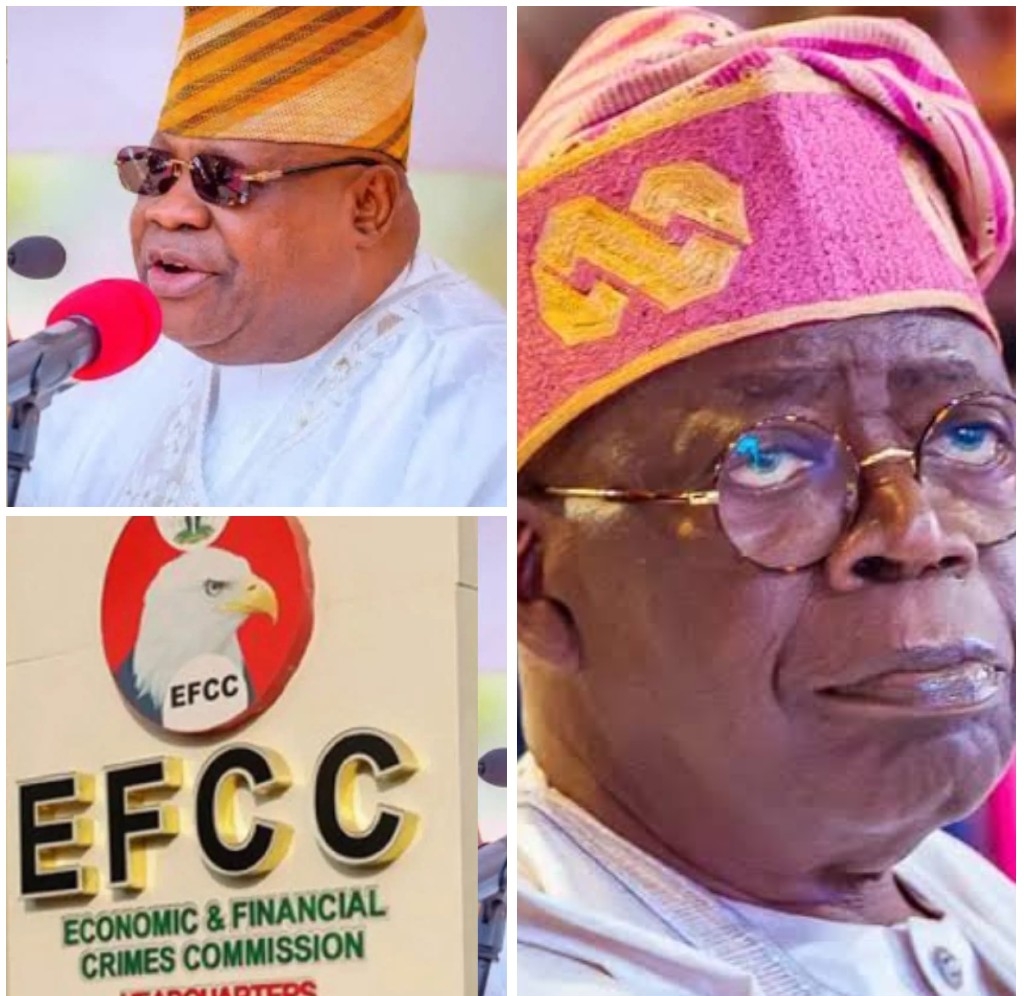
President Bola Ahmed Tinubu’s directive to the Economic and Financial Crimes Commission (EFCC) to return to court and vacate the order freezing the accounts of the Osun State Government is one of the most extraordinary presidential interventions since the beginning of the Fourth Republic. This isn’t because presidents have been strangers to influencing institutions that formally enjoy statutory independence, but it’s simply because this President has publicly acknowledged doing precisely what he has repeatedly insisted he would never do. The significance of the statement therefore lies less in its immediate political effect than in what it reveals about the uneasy relationship between constitutional principle, institutional independence and political reality in Nigeria’s democracy.
The statement is unusual in both tone and substance. Rather than distancing himself from the controversy by invoking the statutory autonomy of the EFCC, President Tinubu accepts political responsibility for the actions of a federal institution. He admits that every consequential action undertaken by an agency of the Federal Government is ultimately attributed to him, whether or not he had prior knowledge of it. His acknowledgement is refreshingly candid. Constitutional lawyers may correctly insist that institutions derive their authority from statutes rather than presidential approval, but Nigerian politics has never operated with such doctrinal precision. The Nigerian public judges the Presidency not merely by its own decisions but by the conduct of the institutions over which it presides. Every prosecution, arrest, and investigation involving a politically exposed person inevitably carries the imprimatur of presidential authority in the court of public opinion. It is a political reality that no occupant of Aso Rock can escape.
But the presidential candour immediately exposes the contradiction at the heart of the statement. Considerable space is devoted to reaffirming his commitment to institutional independence. He reminds Nigerians that he has deliberately refrained from directing the operational activities of the EFCC because democratic governance depends upon strong institutions acting professionally, independently and without political interference. It is a proposition few would dispute. Institutions created by law are intended precisely to insulate the administration of justice from the changing calculations of political convenience. The entire philosophy behind establishing anti-corruption agencies is that investigations and prosecutions should neither begin nor end at the pleasure of the Executive. Having established that principle, however, the President proceeds to depart from it. He directs the very institution whose independence he has just defended to discontinue proceedings it had already commenced before a competent court and to seek the discharge of an order lawfully obtained. It is impossible to ignore the constitutional irony. An institution cannot simultaneously be independent in principle and subject to presidential direction in practice.
The contradiction may be politically understandable, but it remains a contradiction nonetheless.
The justification advanced by the President rests almost entirely upon timing. Significantly, he does not contend that the EFCC acted unlawfully, exceeded its statutory powers or misled the court. He expressly accepts that the Commission acted pursuant to its legal mandate and secured judicial authorisation. His concern is that the freezing of the Osun State Government’s accounts only days before a governorship election creates an appearance capable of undermining public confidence in the electoral process. It is, in essence, an argument that political legitimacy sometimes requires legal powers to yield to democratic prudence. This argument deserves serious consideration. Democracies survive not only because elections are conducted according to law but because citizens believe that the contest is fundamentally fair. In societies marked by intense political competition and enduring distrust of federal authority, perception often becomes as consequential as fact. Whether the EFCC acted from purely investigative motives or not becomes almost secondary once its actions are capable of influencing public confidence in an impending election. A government genuinely committed to protecting electoral integrity cannot dismiss those perceptions as mere partisan complaints. Confidence in democratic institutions is itself a constitutional value deserving of protection.
Even so, constitutional democracies are tested precisely when good intentions collide with constitutional limits. The order freezing the Osun State Government’s accounts was not an executive directive issued by the EFCC acting alone. It was the product of judicial proceedings in which a court, exercising its constitutional jurisdiction, found sufficient basis to grant the relief sought. Once a matter enters the judicial arena, it acquires a constitutional character that extends beyond executive preference. By directing the Commission to return to court and withdraw its application, the President may not have interfered directly with the judiciary, but he has undeniably demonstrated that executive authority remains capable of determining whether litigation initiated by an ostensibly independent agency should continue.
This is a discursive constitutional subject, interrogated by political expediency, that exposes a deeper structural ambiguity within Nigeria’s constitutional order. Independent agencies are often described as operating without presidential control, yet their leadership is appointed by the President, funded through executive budgets and functions within the broader architecture of the Executive Branch. Their independence has therefore always been qualified rather than absolute. President Tinubu’s intervention merely brings into the fore what has frequently remained unspoken. The Presidency retains considerable practical influence over institutions whose legal independence is regularly celebrated in official rhetoric.
There is, however, another dimension to the President’s statement that should not be overlooked. Nigeria’s electoral history is burdened by persistent allegations that federal institutions have occasionally been deployed, or have appeared to be deployed, to shape political contests. Whether every allegation has been substantiated is less important than the cumulative effect such accusations have had upon public confidence. The President evidently recognises that permitting the freezing of a state government’s accounts immediately before an election would almost certainly reinforce long-standing suspicions of federal partisanship. In choosing to intervene, he appears to have concluded that preserving the credibility of the electoral process outweighs the institutional cost of directing the EFCC to retreat. That calculation may prove politically prudent, but constitutional precedents acquire significance precisely because they outlive the circumstances that produce them. If a President may intervene to halt investigative proceedings because an election is imminent, another President may invoke equally compelling political reasons to discontinue investigations involving influential allies, powerful governors or strategically important political actors. Constitutional powers are seldom judged by the restraint of those who first exercise them. They are judged by the possibilities they create for those who come afterwards. Every exception carved out in the name of necessity becomes available for future invocation under less compelling circumstances.
What emerges from this episode is not evidence of constitutional failure but of constitutional tension. The President found himself confronting two principles that point in opposite directions. One required him to preserve the operational independence of an anti-corruption agency. The other required him to safeguard public confidence in the integrity of an election taking place within days. Whichever course he chose would inevitably compromise one constitutional value to preserve another. He chose electoral legitimacy over institutional autonomy. Whether his choice was correct will remain a matter of legitimate disagreement. There will be those who commend the President for preventing an action capable of contaminating the atmosphere surrounding the Osun governorship election. There will equally be those who regard the directive as confirmation that the independence of federal institutions remains contingent upon presidential tolerance rather than constitutional certainty. Both positions find support in the facts.
What cannot be disputed is that President Tinubu has executed a conspicuous U-turn. Having consistently argued that anti-corruption agencies should operate without executive interference, he has intervened directly in one of the most politically sensitive investigations undertaken during his administration. He has done so not because the law required it, but because he concluded that the demands of democratic legitimacy outweighed the discipline of constitutional consistency. Whether history judges that decision as an act of statesmanship or as the reaffirmation of Nigeria’s enduring tradition of executive predominance will depend less upon the immediate withdrawal of the court order than upon whether this remains an exceptional response to exceptional circumstances or becomes another precedent in which institutional independence yields to presidential discretion.

For publication of your news content, articles, videos or any other news worthy materials, please send to newsleverage1@gmail.com. For more enquiry, please call +234-901-067-1763 or whatsapp +234-901-067-1763. To place an advert, please call 09010671763



30-Day Fuel Discount: Nigerians Deserve More Than Temporary Relief – Otunba Babatunde Olushola Senbanjo

FG Announces 30-Day Petrol Discount at NNPC Stations

Orji Mourns Squadron Leader Man-Ugwueje, Describes Fallen Air Force Officer as Servant of Fatherland

“Let Us Unite for Progress” – Onukwuo Says, Mobilises Support for Chinedum Enyinnaya Orji

Odumeje Blasts FG Over Celebration of Existing Onitsha Head Bridge, Says “Holy Ghost Will Kpai You”

Nigeria Needs Leadership, Not Politics of Personal Power – Otunba Babatunde Olushola Senbanjo

Amnesty International Demands Reversal of Madonna University Students’ Expulsion, Suspension Over TikTok Video

“Otti Has Made Your Job Easy, Sell His Achievement” – LP National Secretary Charges Rt. Hon. Agwu U. Agwu’s Campaign Council

Hon. Chidi Nnamdi Consults Hon. Seth Agonumo in Obingwa, Receives Support

2027: Tinubu Will Give Opponents ‘Margin You Won’t Believe’ – Bwala

Ikeji Aro 2026 on Avor Osu Day: Nkita Oku, Inum, Ekpe Erim, Other Ekpo Masquerades Pay Homage to Eze Eberechukwu Oji

97-Year-Old Dr Mrs. Shields Reconstructs, Reopens Mary Slessor Library in Arochukwu

Ikeji-Aro 2026: ‘We Are Repackaging Aro Traditional Healing Practices for the Younger Generation’ – Mazi Ernie Onwumere

2027: Hon. Ike Bishop Okoronkwo Mobilises Abia North Grassroots, Tasks ADC Coordinators on Polling Units

Ikeji-Aro 2026: CPC Chairman Elekwa Explains ‘Aro Renaissance’ Theme, Reveals Plans to Preserve Cultural Heritage

APC Sanctuary: How the Ruling Party Became Nigeria’s Governance Virus – Otunba Babatunde Olushola Senbanjo

Eze Eberechukwu Oji Commissions Amuvi Community Self-Built Connectivity Hub

Nigeria Owes Tobi Amusan a Statue – Abdul Mahmud

Obioma-Ngwa 2027: Chidi Nnamdi Pushes Case for Responsive Representation – Comrade Abuchi Isaac

‘We Will, We Will, We Will’: Atiku Slams Tinubu Over Promises, Questions Achievements After Three Years

The final 6 ‘Game of Thrones’ episodes might feel like a full season
New Season 8 Walking Dead trailer flashes forward in time
Mod turns ‘Counter-Strike’ into a ‘Tekken’ clone with fighting chickens
Meet Superman’s grandfather in new trailer for Krypton
Disney’s live-action Aladdin finally finds its stars
Who are the early favorites to win the NFL rushing title?
The old and New Edition cast comes together to perform
Boxing continues to knock itself out with bewildering, incorrect decisions
Steph Curry finally got the contract he deserves from the Warriors
Phillies’ Aaron Altherr makes mind-boggling barehanded play
-
 Abia State News2 weeks ago
Ikeji Aro 2026 on Avor Osu Day: Nkita Oku, Inum, Ekpe Erim, Other Ekpo Masquerades Pay Homage to Eze Eberechukwu Oji
-
 Abia State News2 weeks ago
97-Year-Old Dr Mrs. Shields Reconstructs, Reopens Mary Slessor Library in Arochukwu
-
 Abia State News3 weeks ago
Ikeji-Aro 2026: ‘We Are Repackaging Aro Traditional Healing Practices for the Younger Generation’ – Mazi Ernie Onwumere
-
 POLITICS2 weeks ago
2027: Hon. Ike Bishop Okoronkwo Mobilises Abia North Grassroots, Tasks ADC Coordinators on Polling Units
-
 Articles4 weeks ago
Ikeji-Aro 2026: CPC Chairman Elekwa Explains ‘Aro Renaissance’ Theme, Reveals Plans to Preserve Cultural Heritage