
Abia State News
Abia Govt Explains Teacher Recruitment Process, Discloses Number of Candidates Who Scored Over Benchmark

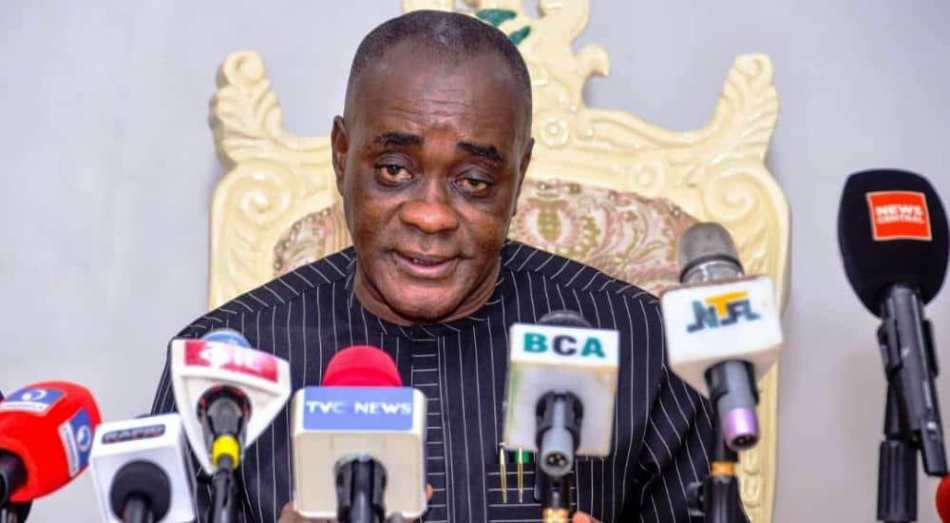
The Abia State Government has explained the process adopted in the recruitment of the second cohort of teachers into public schools, saying the exercise was guided by transparency, subject-specific needs and available vacancies across the state.

The Commissioner for Basic and Secondary Education Elder Goodluck Ubochi, who addressed journalists at a press conference on Thursday, said the recruitment exercise was designed to bridge the shortage of teachers in public schools while ensuring that only candidates needed by the schools were eventually engaged.
According to him, Governor Alex Otti had earlier approved the recruitment of 5,000 teachers, but 5,394 teachers were eventually recruited under the first exercise.
Ubochi explained that after the first recruitment, the government discovered that there were still significant gaps in the teaching workforce and subsequently obtained approval from the governor to recruit another 4,000 teachers.
He said the major difference between the first and second recruitment exercises was the qualification requirement.
“That’s either BE or NCE. But because of the type of needs or the type of teachers needed in our schools, we decided to make the second cohort to be free as long as you have a degree or NCE or whatever qualification you are free to apply,” he said.
He disclosed that about 36,000 applicants applied when the recruitment portal was opened, while approximately 21,000 candidates were invited for oral interviews after an initial assessment.
Ubochi said the government deliberately set the initial benchmark at 40 per cent to make the exercise as inclusive as possible and avoid excluding candidates who could be relevant to the needs of the schools.
He explained that the oral interview was introduced to ensure that candidates were assessed through more than one method and that potentially suitable applicants were not wrongly excluded based solely on written assessment.
According to him, the government subsequently obtained detailed information from principals and heads of schools on their specific manpower requirements, including the number of teachers needed and the subjects in which vacancies existed.
He said the information was compiled across primary, junior secondary and secondary schools and matched against the pool of candidates who had passed through the assessment process.
Ubochi stressed that the final selection was therefore not based solely on a uniform cut-off mark, but on the combination of candidates’ scores and the specific subject and location requirements of schools.
Giving an example, he said 360 candidates qualified for biology when a benchmark of 50.5 per cent was applied, but the state only needed 260 biology teachers.
“We had to cut off. So that means that we were dealing with varying cut-off points. Cut-off points relating to subject needs, subject specifics,” he explained.
He said this was why a candidate who scored 60 per cent could sometimes be excluded while another who scored 55 per cent could be selected, depending on the subject and the number of available vacancies.
Ubochi also cited marketing as an example, saying more than 400 candidates with the qualification scored above 50.5 per cent, but only 11 marketing teachers were required by the Secondary Education Management Board (SEMB), as primary and junior secondary schools did not require marketing teachers.
He said, on the other hand, there were some technical subjects where the number of applicants was fewer than the vacancies available. In such cases, the government took all the qualified applicants.
“There were some technical subjects that only five people applied, and we needed more than five. We took them, the whole five,” he said.
The government official said the approach was adopted to ensure that recruitment was driven by actual manpower requirements rather than arbitrary selection.
He further stated that about 5,785 candidates qualified based on the overall 50.5 per cent cut-off, but the number was subsequently reduced after subject-specific and school-specific needs were considered.
Ubochi insisted that the administration of Governor Alex Otti did not compromise transparency in the recruitment exercise, adding that even commissioners were not given discretion to submit personal lists of candidates.
“That’s why he will tell you, I don’t give you any list. Therefore, nobody is qualified to give you any list. I don’t have my, as a commissioner, I don’t have any list. I don’t have my favourites,” he said.
He explained that the recruitment framework and lists were available to key officials, including the governor, recruitment chairman and relevant officials, to prevent one individual from manipulating the process.
According to him, where vacancies subsequently arise, officials would consult the established list rather than introduce names from outside the recruitment pool.
Ubochi said the government also applied additional elimination measures because of the large number of applicants.
He explained that candidates who were more than five years after graduation or failed to present their original certificates during the verification process were disqualified.
“If you don’t have your original certificate, even if you bring it a week later, you are disqualified,” he said.
He disclosed that candidates who were successful are expected to commence orientation from September 7, with the exercise expected to last between five and eight days.
He added that the successful candidates would subsequently receive additional professional development through collaboration with the Teachers Registration Council of Nigeria (TRCN).
According to him, the government intends to expose the newly recruited teachers to training over a two-year period to equip those without formal teaching backgrounds with the necessary teaching skills.
Ubochi said the decision to open the second recruitment exercise to candidates with qualifications other than conventional teaching degrees was informed particularly by vacancies in technical and vocational areas.
He explained that the government discovered during the first recruitment that many technically skilled individuals did not possess conventional educational qualifications but were nevertheless needed in public schools.
On the new school curriculum, he said the government would commence implementation of the revised curriculum from September, adding that a consultant was already working on developing an enhanced curriculum based on the national curriculum.
He said the curriculum would incorporate elements peculiar to Abia and introduce additional content designed to make it more relevant to the state’s educational environment.
The newly recruited teachers, he said, had already been assigned to the relevant agencies for onboarding, including the Secondary Education Management Board and the agencies responsible for junior secondary and primary education.
Ubochi said the onboarding exercise had commenced and was expected to make significant progress within the next two days, ahead of the deployment of the teachers for the new academic session in September.
He also disclosed that candidates who were not immediately selected because their subjects were not among the current priority areas would not be discarded.
According to him, the government would maintain a recruitment pool from which candidates could be selected whenever new vacancies emerge.
“Most of these leftovers are going to be in a pool. We’re going to have a pool. Today, tomorrow, the next two, three years, we’re not going to conduct any more recruitment exercise. When any need arises, we’ll go back to that pool, pick those who would cover that gap, and then invite them to be in the stream,” he said.
He added that some candidates in the pool could become unavailable by the time vacancies arise because they might have secured employment elsewhere, in which case other qualified candidates would be considered.
Ubochi further addressed concerns over the deployment of teachers to locations outside their preferred communities.
He said recruitment was based on actual vacancies, meaning that a candidate could not insist on being posted to a locatia on whea re his or her subject was not required.
“If somebody from Umuahia is going to teach civic education, and no school requires civic education teacher in Umuahia, we don’t create one,” he said.
He explained that such a candidate could be deployed to a nearby school where the service was required, adding that candidates unwilling to accept such deployment could be replaced by others willing to serve where the need existed.
On accommodation, which he identified as a major concern raised by teachers, Ubochi said the government had begun engaging communities to provide accommodation support.
He said some indigenes living in the diaspora who own houses in their communities had already indicated their willingness to make portions of their properties available for teachers.
He urged newly recruited teachers facing accommodation challenges to communicate with the government so that solutions could be explored.
However, he cautioned that candidates could not expect the government to alter deployment solely to keep them within their preferred locations.
“When somebody wants to remain in his comfort territory and want to force us to push him or her in that area, it will not work,” he said.
Ubochi said the press conference was organised to clarify the recruitment process and address what he described as widespread misunderstanding among members of the public and applicants concerning the different cut-off points.
He added that some applicants who raised concerns about the process after appearing around the government offices the previous day had been given explanations and were satisfied with the information provided.
He reaffirmed that the government’s objective was to ensure that the recruitment exercise remained transparent, merit-based and directly connected to the actual staffing needs of Abia public schools.
For publication of your news content, articles, videos or any other news worthy materials, please send to newsleverage1@gmail.com. For more enquiry, please call +234-901-067-1763 or whatsapp +234-901-067-1763. To place an advert, please call 09010671763





Abia at 35: Chinedum Orji Celebrates State’s Heritage, Unity and Progress

Kaduna Will Repay Tinubu With 2027 Votes, Says Uba Sani

Ibrahim Gusau Resigns as NFF President, Calls on Board Members to Follow Suit

Abia Govt Explains Teacher Recruitment Process, Discloses Number of Candidates Who Scored Over Benchmark

Police Challenge VeryDarkMan to Prove Allegations Linking Officers to Kidnappings

₦30,000 Airport Taxi Fare: FAAN Clears Bolt After E-Hailing Dispute

Ndume: Tinubu Must Act Against ‘Kakistocrats’ Dominating Presidency

2027: ‘Ikuku Hurricane’ Sweeps Across Ikwuano-Umuahia, Group Backs Chinedum Orji

Atiku’s Subsidy U-Turns Expose Policy Confusion, Says Presidency

2027 Elections: We Are Competing With Thieves, Atiku Says

Campaigns: Abia Govt places N200m, N150m charges on Presidential, Governorship candidates

60th Aguiyi-Ironsi Memorial: Tinubu, Otti, Obasanjo, Other Leaders Renew Call for Unity, Honour Nigeria’s First Military Head of State

Breaking! Court Remands Nnachi Divine Mark Idume over Alleged False Viral Publication Against Former Abia Governor Senator T.A. Orji

Tinubu’s Intervention on the Osun Accounts: A Welcome Commitment to Electoral Fairness Within Constitutional Limits – Afikuyomi, Esq.

Accountant-General Alleges Letter Meant to Expose Fake Agency Was Hijacked as Head of Service Admits Due Diligence Failure

#OsunDecides2026: Akpabio Stops Collation – Davido

Otunba Babatunde Olushola (BOS) at 69: Celebrating a Life of Mentorship, Leadership, Compassion and Service

Former IGP Mike Okiro Hoists CityBoy Movement Flag in Abia, Applauds Seyi Tinubu for Creating Movement

Abia Arise Movement Unveils Mega Rally to Reaffirm Support for Governor Alex Otti’s 2027 Re-election

Why Supporters Say Chinedum Orji Is the Right Choice for Ikwuano/Umuahia Federal Constituency in 2027 – Onukwuo

The final 6 ‘Game of Thrones’ episodes might feel like a full season
New Season 8 Walking Dead trailer flashes forward in time
Mod turns ‘Counter-Strike’ into a ‘Tekken’ clone with fighting chickens
Meet Superman’s grandfather in new trailer for Krypton
Disney’s live-action Aladdin finally finds its stars
Who are the early favorites to win the NFL rushing title?
The old and New Edition cast comes together to perform
Boxing continues to knock itself out with bewildering, incorrect decisions
Steph Curry finally got the contract he deserves from the Warriors
Phillies’ Aaron Altherr makes mind-boggling barehanded play
-
 Abia State News4 weeks ago
Campaigns: Abia Govt places N200m, N150m charges on Presidential, Governorship candidates
-
 Abia State News4 weeks ago
60th Aguiyi-Ironsi Memorial: Tinubu, Otti, Obasanjo, Other Leaders Renew Call for Unity, Honour Nigeria’s First Military Head of State
-
 Abia State News4 weeks ago
Breaking! Court Remands Nnachi Divine Mark Idume over Alleged False Viral Publication Against Former Abia Governor Senator T.A. Orji
-
 Articles3 weeks ago
Tinubu’s Intervention on the Osun Accounts: A Welcome Commitment to Electoral Fairness Within Constitutional Limits – Afikuyomi, Esq.
-
 NATIONAL NEWS4 weeks ago
Accountant-General Alleges Letter Meant to Expose Fake Agency Was Hijacked as Head of Service Admits Due Diligence Failure